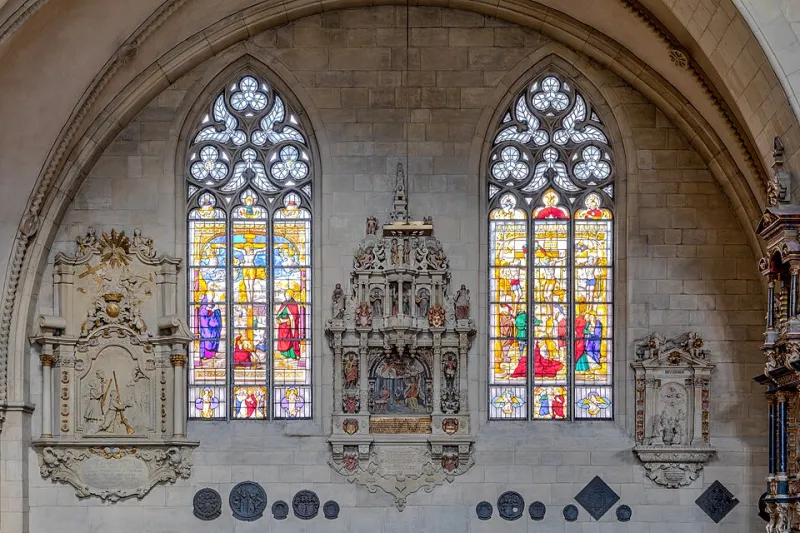
The Conscience of the Craft: Identifying and Keeping Arts and Crafts Stained Glass in a British Home

Photo: Bernard Gagnon, CC BY-SA 4.0, via Wikimedia Commons
The Arts and Crafts window is rarely the loudest element in a period house. It sits at the turn of a stair, above a hall door or in a modest parlour, and it asks to be read rather than merely seen. Between roughly 1880 and 1920, British stained glass absorbed the movement’s belief that craft should be honest, local and humane. For today’s renovator, that legacy is both an invitation and a responsibility: the panels are original fabric, but they are also fragile, leaded assemblies that reward patient attention.
A movement held in transmission
William Morris’s firm and its circle gave the movement some of its most famous windows, but Arts and Crafts glass is broader than any single name. Regional studios, ecclesiastical glaziers and architect-led workshops adapted the ethos to domestic work. The result is not one style but a family of approaches, united by a preference for hand-made glass, visible making and design that grows from the material rather than being imposed upon it.
Look for glass with variation held within it: streaks, seeds, small bubbles and a slight waviness that changes as light moves across the surface. The palette tends to be earthy and modulated—amber, olive, muted ruby, pale gold—rather than the saturated primaries of later commercial work. Lead lines are often purposeful, carrying the design rather than simply dividing colour. Painting is restrained but skilled: trace lines, stippled shading and silver stain used to warm a face, a leaf or a border.
Reading the signature details
Attribution is rarely straightforward. A maker’s mark may be tucked into a corner, a date scratched into a quarry, or a monogram hidden in the border. Morris & Co. panels sometimes carry a small mark or a documented design; smaller workshops often did not. More reliable are the physical signatures: the thickness and profile of the lead, the treatment of the joints, the way the glass is cut and the character of the painting. Photographs of typical leadwork—especially the rounded, slightly irregular cames favoured by some Arts and Crafts glaziers—can help a homeowner compare one panel with another.
Glass texture is equally telling. A panel may combine a plain quarry with a heavily seeded background, or set a painted figure against a streaky field. That deliberate mixture is a hallmark of the period. So is the use of a border that frames rather than competes with the centre. When assessing a window, step back and ask whether the design feels composed for its opening, or merely applied to it.
Condition: the quiet warning signs
Age is not the same as failure. A window can be a century old and sound; it can also be fifty years old and exhausted. The first thing to inspect is the lead. White powdery corrosion, stiff or brittle lead, and panels that have begun to sag or bell are signs that the matrix is losing strength. Cracked quarries—the diamond or rectangular panes—may be isolated accidents or symptoms of movement. Missing saddle bars, corroded ties and failed cement or putty allow water to sit against the glass and lead. Inside, look for condensation, staining on the stone reveal, and paint loss that follows a water track.
Paint loss is not always a disaster. Some flaking is historic and stable; active loss, where flakes are lifting or falling, needs attention. The same applies to broken glass: a single cracked quarry can often be conserved, while a panel with multiple fractures and distorted lead may need full re-leading.
Conservation, not renovation
UK conservation practice starts from minimum intervention. Original glass should be retained wherever possible, even where it is cracked; lead should be replaced only when it can no longer support the panel. A conservator will usually match the existing lead profile and composition, re-use sound glass, and record what is removed. Silicone sealants, cement substitutes and aggressive cleaning agents have no place in a historic window. For listed buildings, Listed Building Consent is likely to be required for substantial works, and conservation area status may also apply. Accredited conservators—those registered with ICON, for example—can advise on specification and on the right level of intervention.
Where protection is needed, secondary glazing or isothermal glazing should be designed to allow ventilation and avoid trapping moisture. The wrong kind of secondary glazing can accelerate decay by sealing a window into a damp pocket. Ask a specialist to specify the detail, not a general glazier.
The ethos in daily care
Arts and Crafts practitioners believed that good work should be lived with, not sealed away. The same applies today. Gentle cleaning with a soft brush and lukewarm water, avoiding harsh chemicals, will do more than occasional drastic intervention. Keep a photographic record. Watch for changes after storms. Maintain the stonework and rainwater goods around the window, because most glass failures begin with water. And resist the urge to improve a panel with new glass that is too uniform or too bright; the point of the original is its quiet variation.
At Stained Windows, the guiding principle is simple: period glass, patient craft and lasting light. The quiet radicalism of these windows lies in their refusal of the machine-made and the merely decorative. To care for them is to continue that argument—patiently, and in good light.