Marks of the Dark: Wartime Modifications to British Period Windows
Photo: Coreymchandler, CC BY-SA 4.0, via Wikimedia Commons
The history of a period window is rarely written only in its lead, glass and joinery. Sometimes it survives in a smear of adhesive along a stile, a band of opaque paint at the edge of a pane, or a row of screw holes in a reveal. Such traces are easily dismissed as damage. In a house that stood through the Second World War, however, they may be evidence of blackout compliance, blast protection or later makeshift repair, and they deserve to be read before they are removed.
Reading the Evidence
Blackout measures were not a single product but a range of responses. Householders were required to prevent light from escaping, and the solutions adopted varied according to the building, the household and the materials to hand. Heavy curtains, shutters, boards and painted glass all appear in the documentary record. So do adhesive tapes, often applied in criss-cross patterns to reduce the danger from flying glass during bombing. The resulting marks are rarely picturesque, but they are part of the fabric of the house.
The first task is therefore observational rather than restorative. A conservator or informed surveyor will look for repeated patterns: parallel lines of residue, rectangular paint margins registering the position of a former blackout frame, or fixing holes at regular centres around a reveal. Repetition matters. A single patch of adhesive may be accidental; a suite of matching marks across several windows suggests a coordinated wartime alteration.
Tape, Paint and Fixings
Blast tape residue is among the most familiar traces. Original tapes were intended to hold glass together if a pane fractured, and their adhesives have often stained or etched the surface over time. The residue may appear as a brownish film, a brittle line or a ghostly cross on the glass. It should not be cleaned aggressively on the assumption that clarity is always desirable. Some adhesives have interacted with historic glass, and abrasive removal can diminish the very surface that records the intervention.
Painted margins are equally informative. A band of dark paint around the edge of a sash pane may have been applied to reduce light spill, or to obscure a view in accordance with local regulations. Where paint has been applied directly to glass, its edge can reveal the width of a former blackout covering. Where it sits on the frame, it may indicate the position of shutters or boards. Fixings are often overlooked: iron hooks, screw eyes and small brackets around a reveal can point to removable blackout panels long since lost.
Genuine Work or Later Repair?
Not every old alteration is wartime. Houses were adapted throughout the twentieth century, and later owners often reused wartime fixings for curtains, secondary glazing or security bars. The question is one of context. Genuine blackout work tends to be consistent across a room or a elevation, and it often coincides with other period details: original joinery, early twentieth-century glass, or documentary evidence such as photographs and family papers.
Materials can help, but they are not decisive. Adhesive residues vary, and paint layers may have been overpainted. A cautious reading considers the whole window. If the fixing holes align with a former blackout frame and the paint margin matches the same opening, the case is stronger than if a single hook survives in isolation. Where uncertainty remains, it is better to describe the evidence as “possibly wartime” than to assert a false certainty.
Document Before Repair
Recording is the essential preliminary to any repair. Photographs should be taken in raking light, which reveals surface texture and residue more clearly than direct flash. Details should include the position of marks on each pane, the spacing of fixings, and the relationship between paint margins and joinery. A simple measured sketch can be more useful than a dozen casual images.
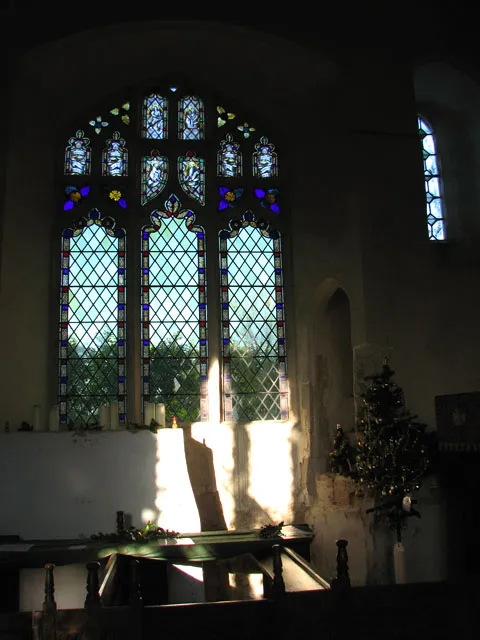
Where glass must be replaced or a frame repaired, the record becomes part of the building’s history. It should be kept with the property documents and passed to future owners. For stained or leaded lights, the same discipline applies: wartime marks may sit alongside original quarries and lead cames, and the two should not be confused. The aim is not to freeze the window, but to ensure that its evidence is not lost through ignorance.
Conserving the Mark in Situ
There are circumstances in which wartime traces should be retained. If the marks are stable, if they form a coherent group, and if they do not compromise the weathertightness or safety of the window, they can be conserved as documentary fabric. This is particularly appropriate where the house retains other wartime features, or where the marks are rare and well preserved. In such cases, cleaning should be minimal and reversible, and any new work should be distinguishable on close inspection.
Retention is not always possible. Decayed timber, failed glazing and hazardous glass may require intervention. Even then, the evidence can be preserved through photography, written description and, where appropriate, the retention of a small sample of tape residue or painted edge beneath a protective cover. The principle is proportionality: the significance of the mark should be weighed against the need for a sound and usable window.
A Measured Approach
Wartime alterations are not the most decorative features of a period home, but they are among the most human. They record fear, improvisation and the ordinary business of keeping a house secure. In 2026, as older windows face pressures from energy performance and replacement, the temptation to erase such traces is considerable. A measured approach distinguishes between dirt and evidence, between later repair and wartime compliance, and between conservation and mere preservation. Handled with care, the marks of the blackout can remain part of the window’s story, quietly visible to those who know how to read them.